What a Labrador at a Bronx children’s hospital can teach physicians, clinic owners, and healthcare innovators about patient experience, administrative waste, and the contrarian idea that healthcare’s next breakthrough may come from preventing work, not automating more of it.
“First, experience – and patient experience in particular – is not a survey or score. Rather, it is something a patient, family members or care partners live through.”
That is Jason A. Wolf, president and CEO of The Beryl Institute, in Healthcare IT News on October 19, 2026. His point is simple: healthcare is not just what organizations measure. It is what people actually experience.
And sometimes, that experience is shaped by a four-legged healthcare worker who has never attended medical school, never opened an electronic health record, and probably has no opinion about artificial intelligence.
Her name is Polly.
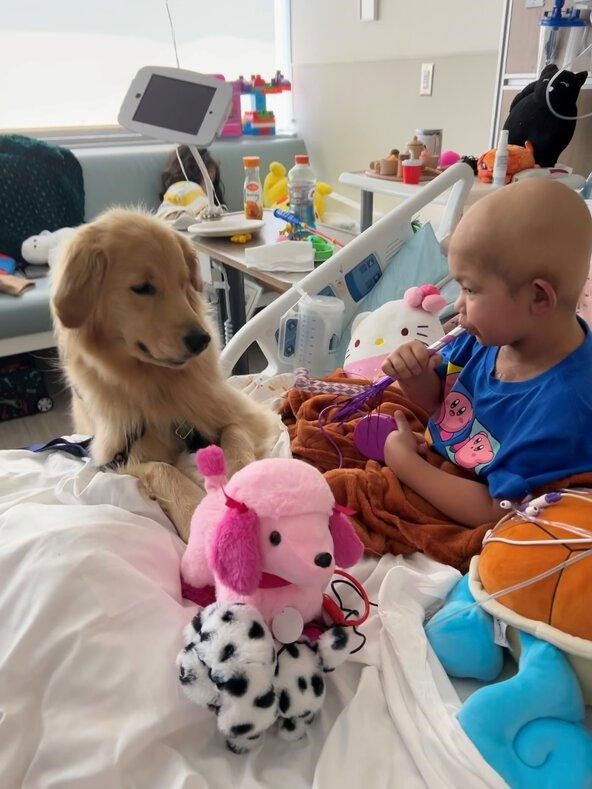
A Dog Named Polly, a Child With Cancer, and an Uncomfortable Healthcare Question
At Children’s Hospital at Montefiore Einstein in the Bronx, New York, a four-year-old Labrador named Polly helps bring comfort to hospitalized children.
According to a New York Post report published October 19, 2026, Polly visited an eight-year-old cancer patient who was experiencing tremors after doctors removed the child’s breathing tube and reduced sedative medications.
Polly works with Katy Dessick, a certified child life specialist. Dessick reportedly observed that the child’s tremors became less frequent when Polly was present.
It is an affecting story, but accuracy matters. This observation does not establish that Polly caused the change in tremors, and it does not mean a facility dog can replace medical treatment. It reminds us that the experience of being ill includes more than clinical procedures.
The report also describes Dr. Adit L. Tal, a pediatric hematologist-oncologist at Children’s Hospital at Montefiore Einstein, discussing the role facility dogs can play in helping young patients feel more comfortable.
Another Labrador, Lev, age seven, visits children at Maimonides Medical Center in Brooklyn, New York. His handler is identified in the report by the first name Gabriel.
These are different people doing different jobs in different hospitals. Yet their stories point toward an important principle: the human experience of healthcare deserves attention alongside clinical treatment.
Now, let’s move from a children’s hospital to a small independent medical practice.
A patient arrives for an appointment. The clinician is ready. The patient is ready.
Then someone discovers the referral is missing.
The authorization status is unclear. The insurance information in one system does not match the information in another. A document that should have been available yesterday now requires three phone calls, two portal logins, and a heroic amount of patience.
Suddenly, the appointment has a supporting cast of administrative problems.
Healthcare has become remarkably good at turning one missing piece of information into a multi-department investigation.
What if the real innovation is not getting better at fixing these problems, but preventing more of them from happening in the first place?
That is the question I believe physicians, clinic owners, and healthcare technology founders should be asking.
My Contrarian Take: Healthcare Does Not Need Another Tool for Every Problem
I am a physician-entrepreneur and founder of OnnX, an AI-powered medical billing software initiative focused on small and medium-sized medical practices.
My perspective is increasingly shaped by one distinction:
Automating work is not the same as eliminating the need for that work.
Suppose a claim is rejected because required information is missing.
One solution is to identify the problem, locate the information, correct the claim, resubmit it, and monitor the outcome.
That may be necessary. But it is not the end of the investigation.
Why was the information missing? Was it never collected? Was it entered inconsistently? Did a handoff fail? Was the requirement misunderstood? Did the information exist but remain inaccessible to the person who needed it?
If the same cause produces the same correction week after week, making the correction faster may improve productivity without solving the underlying problem.
It is a bit like buying a faster mop while ignoring the leaking pipe.
The mop may be excellent. The floor may look better. The water bill remains a mystery.
Healthcare should absolutely improve necessary work. It should also challenge unnecessary work.
Not every denial is preventable. Not every administrative step is waste. Documentation, authorization, compliance, and appropriate review can be essential to safe and accountable care.
The opportunity is to distinguish necessary complexity from preventable rework.
The goal should not be to automate every problem. It should be to make fewer preventable problems occur.
The Administrative Burden Is Not Just an Annoyance
For independent physicians, administrative complexity is a business problem, a workforce problem, and sometimes an obstacle to timely care.
The American Medical Association’s 2025 prior authorization survey, reported in May 2026, surveyed 1,000 practicing physicians. The findings are sobering:
- 95% said prior authorization delays access to necessary care.
- 79% reported that patients abandon treatment because of authorization challenges.
- 26% said prior authorization had contributed to a serious adverse event involving a patient in their care.
- Physicians reported completing an average of 40 prior authorizations per week.
- Prior authorization consumed an average of 13 hours of physician and staff time each week.
- 94% said prior authorization contributes to physician burnout.
- 88% reported that prior authorization increases overall healthcare utilization.
These are physicians’ reported experiences, not proof that every practice faces the same circumstances or that one software product can resolve them. But the findings make one thing difficult to ignore: administrative processes can consume resources that healthcare teams need elsewhere.
Imagine reclaiming even a portion of the time spent chasing information, checking status, and repeating work. What would a practice do with those hours?
More patient communication? Better follow-up? Less overtime? More time for complex cases?
Those are worthwhile questions. But the answers should be measured, not assumed.
Three Perspectives on the Human Side of Healthcare
1. Jason A. Wolf: Patient Experience Is What People Live Through
In his October 19, 2026, Healthcare IT News interview, Jason A. Wolf argued that patient experience extends beyond surveys and scores. It includes the experiences of patients, families, care partners, and the workforce.
The implication for clinic owners is that patient experience cannot be delegated entirely to a satisfaction survey.
A patient who repeatedly supplies the same information, waits for an unresolved referral, or receives confusing instructions is experiencing the system, too.
So is the staff member who spends half the morning tracking down a document that should already be available.
The practical question is not simply, “How satisfied are our patients?”
It is also, “Where does our process create avoidable friction, and what are we doing about it?”
2. Katy Dessick: Pay Attention to the Person, Not Just the Task
Katy Dessick’s work with Polly offers a reminder that care happens in the context of human emotion and vulnerability.
A child facing cancer is not simply a diagnosis, a treatment plan, or a series of clinical measurements. The child’s experience matters.
Likewise, an administrative problem is not merely a line item in a work queue. It may affect a patient’s next appointment, a staff member’s workload, or a clinician’s ability to complete a task efficiently.
The lesson is not that every practice needs a therapy dog. It is that healthcare teams should understand the people affected by the processes they design.
3. Researchers: Good Ideas Still Need Evidence
A randomized clinical trial published in JAMA Network Open in March 2025 examined therapy dogs added to standard child-life support in a pediatric emergency department.
The study included 80 children. At 45 minutes, the group that received therapy-dog support experienced a greater reduction in reported anxiety than the comparison group. At 120 minutes, the difference in child-reported anxiety was not statistically significant.
The study supports a measured conclusion: therapy dogs may help reduce anxiety in this setting, but the results should not be exaggerated beyond the evidence.
Healthcare technology deserves the same standard.
A compelling demonstration is not proof of sustained operational improvement. A promising AI feature is not proof of lower costs. A faster workflow is not automatically a better outcome.
Measure the result. Check the limitations. Keep what works. Change what does not.
These individuals and researchers are included for their relevant perspectives; their inclusion does not imply endorsement of OnnX.
OnnX: Move Intelligence Upstream
OnnX is being developed around an idea: many administrative problems should be addressed before they create downstream work.
Medical billing does not begin when a claim is submitted. The eventual claim depends on information gathered, documented, checked, and transferred throughout the patient’s journey.
A problem that starts upstream can become a correction downstream.
For example, consider a service that requires prior authorization. A practice may need to identify the requirement, collect supporting information, submit the request, track its status, verify the response, and ensure the result is available to the people who need it.
An upstream approach would focus on making those steps visible and reliable before the service or claim reaches a point where missing information causes avoidable disruption.
That means distinguishing a request that has been submitted from an authorization that has actually been approved. It means flagging gaps without inventing answers. It means routing unresolved issues to an accountable person.
The same principle may apply to referral status, insurance eligibility, documentation completeness, coding checks, and claim preparation.
The OnnX design philosophy follows six steps:
Capture → Structure → Preserve → Propagate → Act → Learn
- Capture relevant information at the appropriate point.
- Structure it so it can be interpreted consistently.
- Preserve context rather than losing it between systems.
- Propagate it to authorized people and workflows that need it.
- Act through appropriate, clearly assigned next steps.
- Learn from outcomes and recurring failures.
The ambition is not to replace every system or automate every decision. It is to explore how upstream intelligence can help practices identify information gaps earlier and reduce avoidable administrative work.
This is a product direction under evaluation, not a claim that every capability is already available or that specific savings have been demonstrated.
A responsible healthcare founder should be able to distinguish a vision from a validated result.
Seven Steps Clinic Owners Can Take Now
You do not need a large AI budget to begin improving a process. Start with a problem that is specific, recurring, and measurable.
Step 1: Identify the recurring headache.
Ask staff which administrative issue interrupts their work most often. Look for missing referrals, unclear authorization status, inconsistent insurance details, repeated documentation requests, or preventable claim corrections.
Step 2: Map what really happens.
Document the actual workflow, including handoffs, systems, exceptions, and follow-up. The official process may have three steps. The staff’s spreadsheet, phone calls, and workarounds may reveal ten.
Step 3: Establish a baseline.
Count how often the problem occurs, how long it takes to resolve, and what consequences follow. Record staff time and relevant operational outcomes where practical.
Step 4: Investigate the root cause.
Ask why the problem happened, not just who fixed it. Was information never collected? Was ownership unclear? Did a transfer fail? Was a requirement misunderstood?
Step 5: Standardize the process.
Define what information is needed, where it belongs, who verifies it, and how completion is confirmed. Do not remove safeguards or clinically important exceptions merely to make the workflow look simpler.
Step 6: Pilot a narrow improvement.
Try a structured checklist, clearer ownership, a validated integration, or a carefully scoped automation. Involve the staff who will use it. Keep human review for consequential decisions.
Step 7: Compare results and adjust.
Did the problem happen less often? Did resolution time fall? Did the change create new errors? Did staff find the process easier to use?
If the evidence is weak, do not declare victory because the software has a nice interface.
Six Ways Automation Can Make Things Worse
1. Automating a broken process. A faster bad process is still a bad process.
2. Adding alerts without responsibility. If nobody owns the next action, another notification is just digital confetti.
3. Trusting AI output without verification. AI can miss context, misinterpret data, or produce plausible but incorrect answers.
4. Measuring activity instead of results. The number of tasks automated tells you little about whether the practice improved.
5. Ignoring staff feedback. A tool that looks efficient to management may create extra work for the people using it.
6. Promising savings before measuring them. Claims about reduced denials, recovered revenue, or time saved should be supported by appropriate evidence.
The underlying principle is simple: buy technology to solve a defined problem, not to prove that your organization is keeping up with technology.
Five Myths Worth Challenging
Myth 1: Every denial can be prevented.
Reality: Some denials arise from correctable administrative problems; others involve coverage, clinical documentation, medical necessity, contractual terms, or payer decisions. Diagnose the cause first.
Myth 2: More automation always means lower costs.
Reality: Automation can introduce implementation, oversight, exception handling, and correction costs. Measure the net result.
Myth 3: Billing is only the billing department’s responsibility.
Reality: Billing outcomes can depend on information collected during scheduling, registration, clinical documentation, referral management, and authorization.
Myth 4: AI can replace professional judgment.
Reality: AI may assist with information retrieval, prioritization, and consistency checks. It does not eliminate accountability for clinical decisions, coding, or appropriate oversight.
Myth 5: Patient experience and operational efficiency are separate goals.
Reality: Clearer information and fewer avoidable handoffs may support both, but the benefits should be tested rather than presumed.
Legal and Ethical Guardrails
Healthcare automation must respect applicable privacy, security, billing, coding, and contractual requirements.
Before using a new tool, practices should evaluate access to protected health information, vendor responsibilities, security controls, applicable business associate agreements, auditability, and procedures for handling errors or incidents.
An automated system must not invent clinical documentation, misrepresent authorization status, or submit unsupported claims. AI-generated content should be reviewed at a level appropriate to its intended use and potential consequences.
Ethical implementation also requires attention to fairness, transparency, privacy, and accountability. A tool that saves time but introduces hidden errors is not a success.
Consult qualified compliance, legal, coding, and security professionals where appropriate. This article is educational, not legal or billing advice.
Seven Measures That Matter More Than a Flashy Dashboard
Start small. Choose a handful of measures that reflect the problem you are trying to solve:
- Rework frequency: How often does the same issue recur?
- Resolution time: How long does it take to close the loop?
- First-pass claim acceptance: What share of claims are accepted without initial rejection or correction, using a consistent definition?
- Denial rate by cause: Which causes are within the practice’s control?
- Days in accounts receivable: How long does it take to collect outstanding balances?
- Administrative time: How much staff time goes toward repetitive work?
- Patient impact: Are avoidable delays, repeated requests, or communication failures decreasing?
Interpret changes carefully. Payer mix, claim volume, staffing, and policy changes can affect results. A pilot should be evaluated against a credible baseline, not a convenient story.
What the Future of Healthcare Should Look Like
Healthcare will never be free of complexity. Patients have different needs. Clinical judgment remains essential. Payer requirements and exceptional circumstances will continue to exist.
But complexity is not a reason to accept every source of rework as inevitable.
The next generation of useful healthcare systems may not be defined by how many tasks they automate. It may be defined by how well they preserve information, identify gaps, coordinate handoffs, and support the right action at the right time.
For physicians, that means demanding evidence from vendors.
For clinic owners, it means understanding the problem before buying a solution.
For founders, it means building around real operational needs rather than adding AI because AI is fashionable.
For patients, the hoped-for result is straightforward: less avoidable confusion, fewer preventable delays, and more attention from the people caring for them.
And that brings us back to Polly.
A facility dog cannot repair a broken data handoff. An AI platform cannot replace human compassion. A billing system cannot solve every problem in healthcare.
But each has a role when it serves the people who depend on the system.
Polly’s story reminds us to look beyond the procedure and see the person. The administrative burden reminds us to look beyond the rejected claim and investigate the process that produced it.
Perhaps healthcare’s next breakthrough is not doing everything faster. Perhaps it is needing to fix fewer things in the first place.
Your Turn: What Work Should Never Have Existed?
If you own or operate a medical practice, consider this question:
What is one recurring administrative task in your practice that should be prevented rather than automated?
Share your experience in the comments. Your answer may help another practice recognize a problem it has accepted as normal.
If this perspective resonates with you, repost the article to start a conversation among physicians, clinic owners, medical billers, and healthcare innovators.
I am exploring these questions through OnnX and welcome thoughtful perspectives from people doing the work every day.
PS: Visit the Featured section of my LinkedIn profile for a free resource. No signup is required.
References and Further Reading
1. Patient experience and leadership
Jason A. Wolf, president and CEO of The Beryl Institute, discusses why patient experience should be part of organizational culture and strategy, not merely a score.
Healthcare IT News, October 19, 2026: Patient experience is not a score – it’s a leadership strategy
2. The administrative burden of prior authorization
The American Medical Association’s 2025 physician survey, reported in May 2026, describes physicians’ experiences with delays, workload, and prior authorization reform.
3. Research on therapy dogs and pediatric anxiety
A randomized clinical trial evaluated therapy dogs alongside standard child-life support in a pediatric emergency department.
Kelker et al., JAMA Network Open, March 3, 2025: Therapy Dogs for Anxiety in Children in the Emergency Department
4. The original human-interest story
The report describing Polly, Katy Dessick, the child, and facility dogs working at New York hospitals.
New York Post: How dogs at NYC hospitals are helping sick kids heal
About the Author
Dr. Daniel Cham is a physician, medical consultant, and entrepreneur working at the intersection of healthcare technology, practice management, and medical billing. He is the founder of OnnX, an initiative exploring how upstream intelligence may help independent medical practices identify and reduce preventable administrative work.
His focus is on translating healthcare’s operational challenges into practical questions, evidence-informed improvements, and better experiences for physicians, staff, and patients.
Connect on LinkedIn.
Continue the Conversation
- Website: DrDanielCham.com
- Spotify: Listen to the podcast
- YouTube: Watch and subscribe
- X: Follow updates
- Facebook: Join the discussion
- Substack: Read more insights
- TikTok: Watch short-form perspectives
- Instagram: Follow on Instagram
- Threads: Continue the conversation
- Reddit: Join community discussions
- Quora: Explore answers and insights
Knowledge drives progress when we challenge accepted practices, learn from evidence, and turn useful insights into better healthcare operations.
Disclaimer: This article is for general educational and informational purposes only. It is not medical, legal, billing, coding, compliance, or financial advice. Requirements and circumstances vary. Consult qualified professionals for advice on specific situations.
#Healthcare #MedicalBilling #HealthcareAI #RevenueCycleManagement #PhysicianEntrepreneur #PracticeManagement #PatientExperience #HealthTech #HealthcareInnovation #OnnX #IndependentPractice #AdministrativeBurden #PatientCenteredCare
Leave a Reply